JEM RESTYLING
by Paul Mitchell
If there is a link on an image it displays a larger image in a new window.
p1
p2
p3
Background
I acquired my Jem in 1975, unregistered, un-roadworthy and extremely
unloved, having rescued her from the weeds of an Adelaide backyard.
Her previous owner had used her for circuit racing, but when I found her
she was a kid's cubby house.
Back in my garage I found she had a perspex windscreen, a weary 1100
motor, no brakes to speak of, questionable wiring, damaged front wings and
paint that had been thrown on with a bucket!
The initial rebuild was with a view to getting her registered for
roadwork, but after several frustrating trips to the Motor Transport
Department I decided it was all too hard, and satisfied myself with circuit
racing and the occasional club permit run. I installed a Mk2 Cooper S motor
and mechanicals, a roll cage, wider front wheel arch flares and lots of
go-fast stuff to make race day a little more interesting!
In 1992 the idea of driving her half-way across the country to the
Minifest 30 in Sydney and Bathurst started another rebuild with full road
registration in mind, incorporating civilized things like a laminated glass
windscreen, a heater and internal linings. The wiring was completely renewed
and the mechanicals brought to as-new condition.
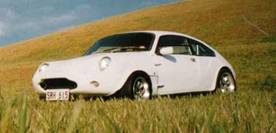 Now as much as I admire the workmanship and dedication that goes into the
restoration and reconstruction of historic vehicles to concourse original
condition, I have always had a desire to individualise my own car, after all
that was why I had acquired a kit-car in the first place. So I set to work
designing and building an opening rear hatch and cabin divider which made
access to the luggage much easier and a lot safer.
Now as much as I admire the workmanship and dedication that goes into the
restoration and reconstruction of historic vehicles to concourse original
condition, I have always had a desire to individualise my own car, after all
that was why I had acquired a kit-car in the first place. So I set to work
designing and building an opening rear hatch and cabin divider which made
access to the luggage much easier and a lot safer.
After several more visits to the Motor Registry Department I finally
convinced them that the Jem was roadworthy and was issued with full type
registration and headed off on the 2500klm round trip to the Minifest in
Sydney. I could be wrong, but I believe mine is the only Australian Jem that
has been registered as such. All the rest were registered before the need to
identify the body shell and were registered simply as a Mini.
That initial trip showed me what was needed to make the car useable as an
everyday means of transport. The first thing was fresh air vents ducted from
beside the radiator to the dash, the next was a better muffler system.
Around OZ
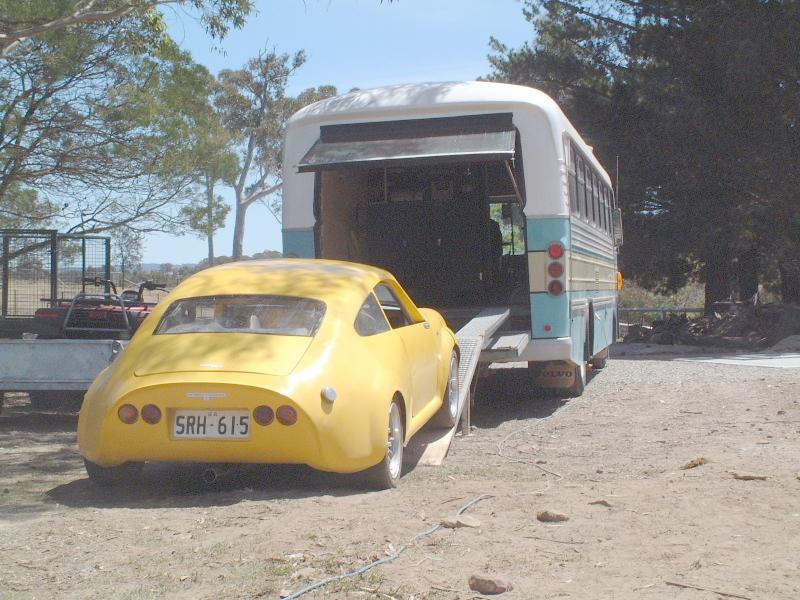
 In 1994 my wife and I set out in our 30 foot Bedford motor-home on a working
holiday around Oz that ended up lasting 8 years!
In 1994 my wife and I set out in our 30 foot Bedford motor-home on a working
holiday around Oz that ended up lasting 8 years!
I had built the motor-home with the capacity to carry a small car in the
back. We started off with our old faithful Leyland Minivan, but after it
virtually dissolved from rust in tropical Queensland, I flew down to
Adelaide, drove the Jem back up to Mackay and used her for the rest of the
trip. You can't beat fiberglass cars for standing up to extreme weather
conditions! That 4500klm trip took 5 days (5days x 8hrs x 110klm/hr) and the
Jem never missed a beat.
Our working holiday took us right around the coastline of Australia
staying a about year in each place. We parked the motor-home in the
sea-front caravan parks, and whenever I backed the Jem out, a crowd would
gather. I was usually asked to do it all again for the video cameras.
At the end of each stay I'd pack her away again and off we'd go to the
next place - more cameras!
When we were in Broome (top end of Western Australia) I had to put her
away in the motor-home in a real hurry - a cyclone was bearing down and all
hell was about to brake loose. Luckily the center of the cyclone missed the
town but we still copped 160kph winds for several hours.
Next day the place was mess but luckily the motor-home and Jem was safe
and there was no damage.
The Jem and I went to some places that were about as remote as you can
get - and still be on a bitumen surface!
Time for a Change
During the last year of the trip around Oz I decided to undertake some
restyling of my Jem, making cosmetic changes to the body-shell to bring her
looks more up-to-date, whilst still retaining the car's original form. For
instance I've always thought that the hump over the rear wheel was a bit of
an affectation and served no real purpose. The line of the window sill
sloped backwards and gave her a drooped rear-end look. The windscreen
surround rubber was bulky and not very aerodynamic. The tiny engine access
bonnet was next to useless and the source of much aggravation!!!. The front
radiator opening was barely large enough for the fresh-air ducts, oil cooler
and radiator. On hot days the sliding windows were a waste of time and my
doors were badly warped anyway - and talking of doors, I was keen to get rid
of the external door hinges and handles. Don't get me wrong, the things I'm
talking about are what make the Jem so typical of the mid 60's British
sports car designs which I'm very fond of.
However there's a place for speculation as to "what if" the design had
gone on developing, instead of ceasing production in the mid 70's.
The restyling was to incorporate the following:
- New flip-bonnet with vertical front
- Wider radiator opening
- Flushed front indicator lights
- Flushed windscreen
- New doors with removable windows
- Concealed door hinges
- Reshaped rear side windows
- New rear side panel skins
- Side sills and wheel arch flares
The work was to be cosmetic only, with no structural alterations to the
shell - I can always return it to original.
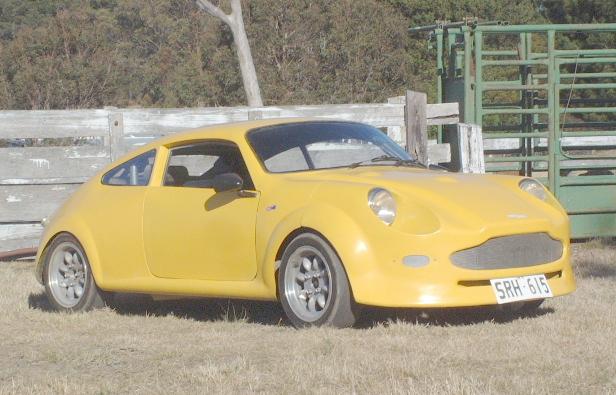
These changes were done after a lot of careful planning and mocking-up,
aiming to make the finished style changes as subtle as possible - what I
think the Jem could have become had it stayed in production with continual
styling development over the years.
I didn't want it to have that "bolted on" look, or the alterations
looking too obvious or outrageous.
My approach was one of respect for the original design.
I aimed to achieve unity of form with linking items blending the new and
existing elements together. By keeping the lines clean and well defined the
overall character became clearer and still suited to the small size of the
vehicle.
By raising the sill line at the rear, a better balance of the side mass
was obtained. The elimination of the door hinges and the flushing of the
windscreen take 20 years off the apparent age, while the removal of the door
handles and windows harks back to the sports cars of the 50's.
I widened the radiator opening by about 25mm each side, retaining one of
the cars' most recognisable features.
I thought long and hard about undertaking these changes before I began,
but I can only say that the response of the general public has been very
positive.
I am often stopped in the street and asked about her. These days most
people have never seen or heard of a Jem, and are none the wiser as to the
changes that I have made.
Those "older folk" who do remember the Jems instantly recognize it
....take a slow walk around her.....but can't quite put their finger on
what's different. It's only when you see her next to an original that the
changes become obvious.
I take this as confirmation of success.
continues...
© 2004 Paul Mitchell, Adelaide, South Australia



 Last updated 8th March, 2013